
The cheat sheet is intended for 32-bit Windows programming with FASM. One A4 page contains almost all general-purpose x86 instructions (except FPU, MMX and SSE instructions).
What is included
You will find various kinds of moves (MOV, CMOV, XCHG), arithmetical (ADD, SUB, MUL, DIV) and logical (AND, OR, XOR, NOT) instructions here. Several charts illustrate shifts (SHL/SHR, ROL/ROR, RCL/RCR) and stack frames. Code samples for typical high-level language constructs (if conditions, while and for loops, switches, function calls) are shown. Also included are quick references for RDTSC and CPUID instructions, description of string operations such as REP MOVSB, some code patterns for branchless conditions, a list of registers that should be saved in functions, and a lot of other useful stuff.
The idea is to put all reference information about x86 assembly language on the one page. Some rarely-used instructions such as LDS, BOUNDS or AAA are skipped.
Notation
The cheat sheet use common notation for operands: reg means register, [mem] means memory location, and imm is an immediate operand. Also, x, y, and z denote the first, the second, and the third operand. Instruction mnemonics are written in capital letters to make them easier to find when you are skipping through the cheat sheet.
Example
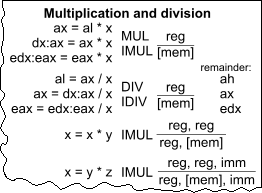
For example, let's look at multiplication and division section. There are instructions for signed (IMUL) and unsigned (MUL) multiplication. Both instructions take one operand, which may be register (reg) or memory ([mem]). There are three possible cases:
- If operand size is one byte, MUL or IMUL multiplies it by al and stores the result in ax
- If operand size is a word, MUL or IMUL multiplies it by ax and stores the high-order word of the result in dx and the low-order word in ax.
- If operand size is a double word, MUL or IMUL multiplies it by eax and stores the high-order dword in edx and the low-order dword in eax.
There are also two-operand and three-operand forms of IMUL shown on the figure above.
Other features of assembly language are described in a similar way.
Download
The cheat sheet is designed for A4 page size; if you print it on US Letter paper, you will get large margins. You can print the cheat sheet and put it on your table to look for some instructions when you forget them.
Download Win32 Assembly Cheat Sheet (PNG picture, 713 Kb)
Serbo-Croatian translation of this article by WHG Team.

25 comments
And the FPU instructions? When will be added?
Drop me an email if you decide to add it, gives the sheet more 'complete'-look :D
Note that some other instructions are not included: LOOP, JECXZ, XLAT, BOUNDS, PUSHA/POPA, LAHF, SAHF, bit operations (BT, BTS, BTR, etc.), decimal and ASCII operations (AAA, DAA, etc.), and segment registers loading (LDS, LES, etc.).
I think it's better to include more information about modern features (say, CPUID flags) than to talk about obsolete instructions such as LODS or XLAT.
Anyway, it's always a compromise, because you can't put all information about x86 architecture on one A4 paper sheet. You have to skip something.
I learned to use it from old tutorial.
Anyway, are you going to make it double-paged, maybe with more hints how to use instructions?
(I like it how it is now, but having stuff on otherside of the paper is always a plus)
Link is to Cheat Sheet is not working, I was going to download and print it to my friend, but no matter what I tried, it always redirected me to that the very same post.
* Intel Assembler x86 CodeTable lists popular x86 instructions on two pages. It also includes a diagram of the registers and a simple 16-bit program.
* New complete x86 and x87 reference consists of a large table with opcode, description, and modified flags for each instruction. It is intended for both on-screen viewing and printing.
x86 registers:
http://www.nairam.sk/pc01.pdf
x86 instructions:
http://www.nairam.sk/pc03.pdf
http://www.nairam.sk/pc05.pdf
Hi, I'd like to learn "assembly"at home.
I can program in java but I don't know anything about "assembly". I say ANYTHING.
Where do I start?
Thank You Mr Peter.
It helped me a lot.
great Peter, thank you.
regards
mater
Thank you, by this very helpful site :)
Kind regards,
Marco
student: example count cube in assembler tasm x86
thank you for the best work , it's useful.